
Category: Uncategorized


Campaign for Trade Union Freedom statement on the unlawful attack on Venezuela by US forces
 The Campaign for Trade Union Freedom adds its support to the growing international condemnation of Trump’s aggressive, imperialist policy towards Latin America.
Trump’s assault on Venezuela did not commence on 3rd January 2026. The war against Venezuela began in 2001, after President Hugo Chávez passed a law bringing all national oil reserves under the control of the Venezuelan Bolivarian Republic.
The new Venezuelan law disadvantaged oil conglomerates, most of them from the United States, instead allowing the Venezuelan government to redirect a larger share of oil revenue towards social programmes and long-term national development.
The illegal attack on Venezuela in 2026 and the abduction of its president and first lady are part of this long, continuous war against the working people of Latin America.
International law offers three main protections against the kind of aggressive force. Without the sanction of the United Nations Security Council it is unlawful for one country to:
- threaten or use force against another;
- interfere in the internal (or external affairs) of another;
- to violate the diplomatic immunity of the head-of-state of another country.
Trump’s statements make it clear that the US attack on Venezuela and abduction of President Maduro and Cicilia Flores is intended to allow the US to take control of Venezuelan oil and the revenue from it.
That revenue is the basis of the entire social programme underpinning the Bolivarian Revolution and since the time of Chavez has lifted millions out of poverty.
The oil industry is the largest industrial employer and historically has been one of the best union organised sectors in Venezuela.
Trump’s statements also make it clear that his aggression on behalf of US corporate interests will not stop at Venezuela. Cuba, Colombia and Greenland are similarly under threat.
The Campaign for Trade Union Freedom stands with the trade unions and workers of Latin America and calls for international law to be upheld; for Maduro and Flores to return home and, for Latin American countries to be free to determine their own social, economic and political futures, free from US interference.
An emasculated Employment Rights Act gets over the line
 By Tony Burke, Co-chair of the Campaign for Trade Union Freedom
And so the Labour Government’s Employment Rights Act is finally through the House of Lords, as Tory peers faced the threat of sitting through Friday and Saturday in the week before Christmas.
The Tory peers were under great pressure from the CBI and other employers’ bodies worried about losing concessions they had already gained, day 1 rights extended to six months, so they dropped their final Amendment to the Bill (in regard to compensation payments from Employment Tribunals) after trying to wreck it altogether – aided and abetted by Lib Dems peers.
The Employment Rights Act is a long way short of what was promised in the Green Paper New Deal for Working People but nonetheless even in its diluted form it was a clear Labour manifesto commitment that the unelected Lords sought to water down even further to the point where Unite General Secretary Sharon Graham said it was “‘shell of its former self.”
Of particular note is the fact that the Bill was opposed by 47 hereditary peers in one vote and 33 in another that defeated the Government by 24 votes.
As the Campaign’s Lord John Hendy KC has pointed out there is the so-called “Salisbury convention that Bills fulfilling the Government’s manifesto commitments must be allowed to pass.”
He also notes “the struggle over the Employment Rights Bill, and the House of Lords’ repeated attempts to block the Government’s elected programme of stronger employment protections, is more than a quarrel about constitutional etiquette. It is a test of whether our democracy still has the capacity to deliver for working people.”
The Labour Government had already succumbed to pressure from employers on key areas of the Bill such as on zero hours, fire and rehire, day one rights, union rights to have access to workers. They sacked key ministers driving the bill through parliament – for no apparent reason other than to appease the employers’ lobby – causing disbelief and anger across the labour movement.
Unions, lawyers and employment law specialists warned that the essential content of the Bill was a platform of (although welcome) employment rights for individual workers, that mainly have to be enforced by application to the Employment Tribunal, rather than collective rights for unions and union members.
The average wait for an Employment Tribunal hearing is around 335 days (approximately one year) from the claim being lodged, longer for more complex cases. Research has shown that in 2013 51% of successful applicants were never paid their compensation by employers; in 2025 75% of applicants using the Government’s Employment Tribunal Penalty and Naming Scheme have not received their awards. Little wonder that unrepresented applicants would in all likelihood just not bother.
Previous experience with the Blair Government shows a Labour government is highly susceptible to pressure from the employers’ lobby, for example, the recognition procedures that allowed for non-independent unions to usurp rights originally thought only would be enjoyed by bona fide independent unions, said to have been enacted at the behest of the Murdoch print and media empire.
However, on more than one occasion Blair was confronted with concerted opposition from the House of Lords. On such occasions Blair faced down the Lords which was ultimately more successful than appeasement.
So after a deal was apparently done to set the qualifying period for ordinary unfair dismissal at 6 months we now have a still welcome (it would be churlish not to give it a welcome), but deficient, Employment Rights Act.
It may be that the movers and shakers in Congress House view the Starmer Government being one term only and will spend the next two years or so, before the next General Election, dealing with the innumerable consultations that will arise to give effect to the new rights through Regulations.
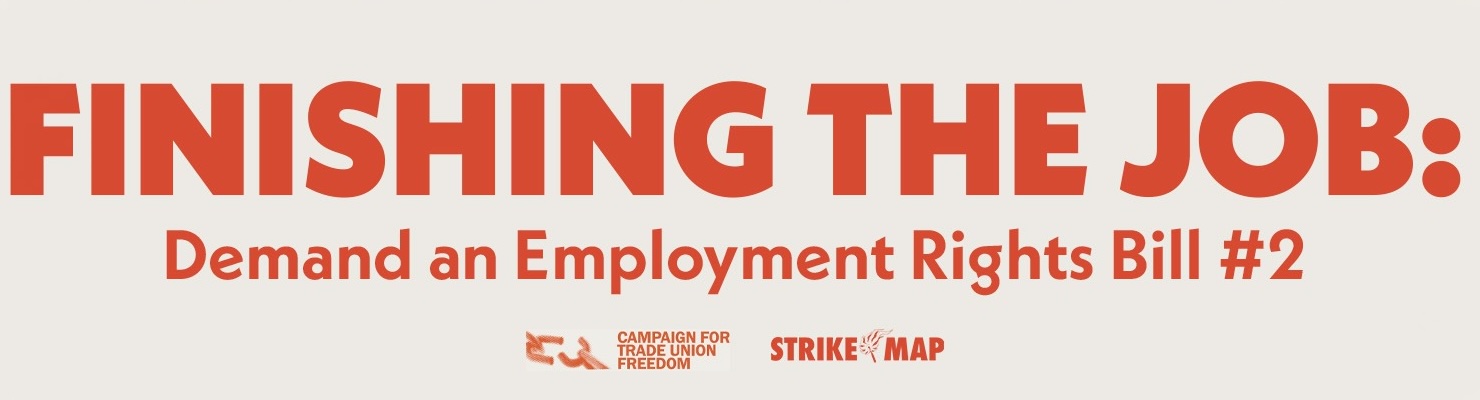
The Campaign for Trade Union Freedom however is calling for an Employment Rights #2 Bill to be introduced in this Parliament. The new Bill would be to implement the many areas of collective rights missing from the current version including statutory support for sectoral collective bargaining, the right to strike and to take solidarity action, a single status of workers and for proper and readily enforceable remedies.
The Campaign will be holding a major rally in March 2026 to campaign for an essential Employment Rights #2 Bill and to call for the Regulations related to the new law remaining consistent with the manifesto and for no further watering down during their drafting and consultation.
This blog first appeared on Labour Outlook https://labouroutlook.org/2025/12/19/an-emasculated-employment-rights-bill-gets-over-the-line-campaign-for-trade-union-freedom and then subsequently in the Morning Star https://www.morningstaronline.co.uk/article/emasculated-employment-rights-act-gets-over-line
Who Does Parliament Serve?
 By John Hendy
The House of Lords’ repeated delays to the Employment Rights Bill have become a test of how — and for whom — Britain’s democratic institutions function.
Parliamentary ‘ping-pong’ occurs where the House of Lords fails to agree a piece of proposed legislation with the House of Commons. The Commons sends a bill it has approved to the Lords, who then amend it and send it back to the Commons.
If the Commons rejects those amendments, the bill goes back to the Lords, which may seek to reintroduce their amendments (or ones very similar to them), and the bill goes back to the Commons.
The conventional limit is three sessions of ping-pong, but on occasion the process lasts longer. There is also the Salisbury convention that bills fulfilling the government’s manifesto commitments must be allowed to pass. If ultimately the Lords and Commons cannot agree, the bill falls. There is then the backstop of the Parliament Act 1911, which allows the Commons to reintroduce the Bill in the next session of Parliament and override the Lords, but this takes time and is very rarely used in practice.
Obstruction and delay
The Employment Rights Bill has been subjected to a series of Lords amendments which have been rejected by the Commons on each of the three ping-pong rounds so far. However, in late November five unions and the TUC met with a range of employers’ organisations and reached a deal under which the government would amend the bill by inserting a six-month qualifying period for entitlement to unfair dismissal rights, together with the removing of the statutory limit on unfair dismissal compensation in return for the bill being allowed to pass.
The first element of this deal, the six-month qualification period, had been targeted by Lords’ amendments. The Commons and the unions opposed these changes, since the government manifesto commitment was that all rights should be available from day one of employment. In reality, the government had all but abandoned that commitment through an early amendment to the bill providing for mandatory probationary periods, mooted to be nine months, during which protection against unfair dismissal would only be partial.
The second element, the removal of the cap on compensation, was not in the manifesto but was a prominent part of the original statement of Labour Party policy, A New Deal for Working People.
The agreement reached was honoured by the government which put forward amendments to give effect to the deal. The Commons approved them on Monday 8 December. However, when the bill reached Lords on 10 November, the Tories accepted the amendment requiring a six-month qualification period but moved two further amendments. One was defeated but one succeeded.
In contrast, the Liberal Democrats and a cross bencher, who had previously insisted on other amendments rejected by the Commons, decided not to put them to the vote, recognising that it was not appropriate to continue opposing the elected House.
The upshot is that the Bill will go back to the Commons today, Monday 15 December, where the government has announced that they will make no further concession and will reject the Tory amendment. The Bill will return to the Lords on Wednesday 17 December.
The single outstanding amendment on which the Tories have staked their resistance to the bill is the proposal to remove the statutory limit on unfair dismissal compensation. The current limit on compensation for unfair dismissal is £118,223, or one year’s salary, whichever is lower. It is to this that the Tories object, notwithstanding that the change would only benefit high-earning claimants, to whom the Tories might be expected to be sympathetic.
The change obviously will be of no use to the ordinary claimant earning less than £118,223 per annum. In contrast, the net median annual wage is less than one third of that figure, and the current median award for unfair dismissal compensation is a miserable £6,746.
If the Tories continue to press for an amendment to remove the government’s removal of the statutory limit on unfair dismissal compensation, this will be the ultimate proof that obstruction of the bill is their objective rather than an objection to highly-paid unfairly-dismissed individuals receiving the full measure of their loss.
In fact, the real problem with unfair dismissal compensation — quite apart from how low it is — is that so few of those who are awarded it actually receive it. The latest government survey in 2013 found that only 49 percent of those awarded compensation had been paid in full. A further 16 percent had received only part of their award. That means that over one third of successful claimants never receive any part of their award. Despite repeated enforcement initiatives, most unpaid tribunal awards still go unenforced, and the Bill does little to change that, yet even this limited reform faces obstruction.
The struggle over the Employment Rights Bill, and the House of Lords’ repeated attempts to block the government’s elected programme of stronger employment protections, is more than a quarrel about constitutional etiquette. It is a test of whether our democracy still has the capacity to deliver for working people.
Lord John Hendy KC is a Labour peer and labour lawyer. He is the chair of the Institute for Employment Rights (IER) and Vice Chair of the Campaign For Trade Union Freedom This article appeared in Tribune December 12th.