

CTUF At The Durham Miners Gala & Tolpuddle Martyrs Festival 2026
The Campaign For Trade Union Freedom will be holding meetings at the 2026 Durham Miners Gala & Tolpuddle Martyrs Festival on the campaign for an Employment Rights Bill 2.
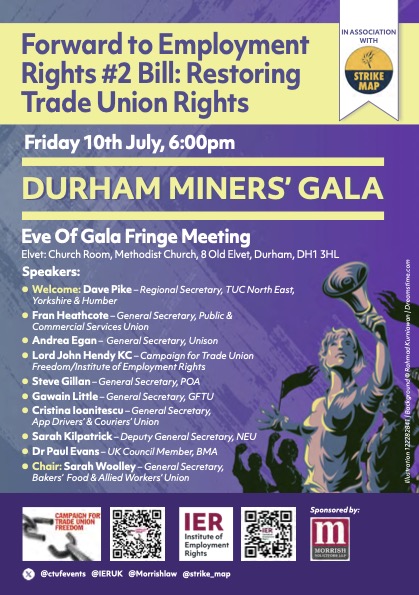
Durham Miners Gala
Friday, July 10th at 6:00 pm
Methodist Church, Old Elvet, Durham, DH1 3HL
Welcome by Dave Pike, TUC Regional Secretary, Yorkshire & Humberside
Fran Heathcoate, General Secretary, PCS
Andrea Egan, General Secretary, Unison
Lord John Hendy KC, CTUF and IER
Steve Gillan, General Sectary, POA and TUC President 2026
Gwain Little, General Secretary GFTU
Christina Ioanistescu General Secretary, App Drivers & Couriers Union
Sarah Kilpatrick, Deputy General Secretary, NEU
Dr. Paul Evans, UK Council Member, BMA
Chair: Sarah Woolley, Co-chair CTUF & General Secretary BFAW
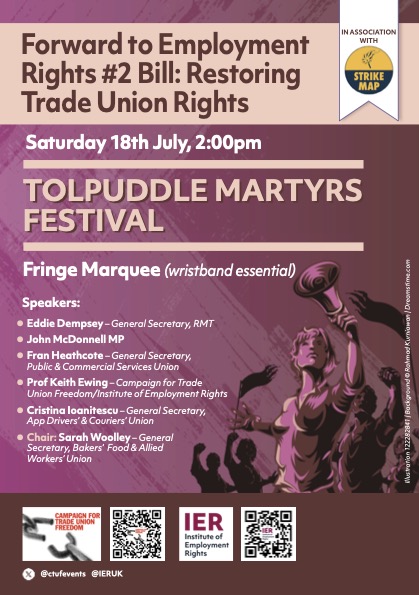
Tolpuddle Martyrs Festival
Saturday, July 18th at 2:00pm
Fringe Marquee, Tolpuddle Festival Site
(Wistband Essential)
Eddie Dempsey, General Secretary, RMT
John McDonnell MP
Fran Heathcoate, General Secretery, PCS
Professor Keith Ewing, CTUF & IER
Christina Ioanistescu, General Secretary, App Drivers & Couriers Union
Chair: Sarah Woolley Co-chair CTUF & General Secretary BFAWU
Why We Need An Employment Rights Bill 2

Speech by Adrian Weir (CTUF Assistant Secretary) to PPPS (Morning Star) AGM
4th June 2026, NEU, Hamilton House, London
Comrades, in moving this motion I want to talk about trade union power.
The Employment Rights Act as its stands is OK; it would be churlish to decry the attempts to deal with zero hour’s contracts and fire and rehire.
Plus the implementation of statutory sick pay from the first day of absence, the reduction in qualifying time before being able to pursue a claim for unfair dismissal and, the extension of family friendly rights.
What the Act does do is increase individual workers’ rights at work mainly enforced through the Employment Tribunal.
What it does not do for trade unions is what was promised in Labour’s Green Paper New Deal for Working People.
Yes, we welcome the repeal on the Minimum Service Levels laws brought in by the Tories in 2023 and also the repeal of most of the Trade Union Act 2016 that introduced super majorities in industrial action ballots in important public services.
We may note that the 50% turnout threshold is still in force for everyone, important public service or not.
But the limitations of trade union power were mainly introduced in the series of anti-union laws brought in in the 1980s and ‘90s under Thatcher and Major.
Laws that limited trade union power but were introduced under the mantra of giving unions back to their members.
It was these laws that introduced the complex ballot arrangements for industrial action, that outlawed solidarity action and generally trapped unions in a legal web that breaches of the law invited employers to run off to the High Court to get an injunction to get the whole thing called off.
The complexity of these laws was one reason why the UK was on multiple occasions found to be in beach of international standards, ILO Conventions, which the UK Government had actually signed up to.
New Deal for Working People promised firstly, to repeal anti-union laws and, secondly, ensure British labour law complied with international labour standards. The Employment Rights Act falls woefully short on this count.
Why does any of this matter?
Because in the decade before the advent of Thatcherism and neo-liberalism the difference between the incomes of those at the top and bottom in society were at their narrowest.
Union led collective bargaining had ensured that there was an equalising effect in the economy – over 80% of the workforce, in a union or not, had their wages, terms and conditions determined by collective bargaining.
Now, only about 20% of workers are covered by collective bargaining and the gap between rich and poor is ever widening.
The point of the Thatcher labour law reforms were not to give unions back to their members but to neuter union power.
To restore to the 1% that which had been taken from them in the years since the Second World War.
So, we need a second Employment Rights Bill to provide statutory support for sector wide collective bargaining.
We need a second Employment Rights Bill to restore a right to strike.
Because comrades, without a right to strike collective bargaining is reduced to collective begging.
Text of the Motion:
The Employment Rights Act passed in December 2025. As predicted by CTUF, IER and Strike Map, the Act falls far short of delivering the proman Employment Rights Aised New Deal for Working People. A campaign for a second Employment Rights Bill has therefore been launched. We congratulate the Morning Star for continuing to promote that campaign, which has now attracted the support of 19 national organisations.
An Employment Rights #2 Bill would demand the following:
- An Immediate repeal of all anti-union laws.
- A full ban on ‘fire and rehire’, enforceable by injunction.
- An end to all zero-hours contracts.
- A £15 per hour minimum wage with no age exemptions.
- A statutory right to collective bargaining for all workers and a legal mechanism for creating sector-wide collective bargaining.
- Amending our labour laws to comply with international standards.
- Universal employment rights, including for workers on working visas, through a single worker status.
- All workers to be entitled to all employment rights from day one.
- A full trade union right to access workers on employers’ premises, enforceable by injunction.
- End restrictions on industrial action and introduce a positive right to strike, including the right to take solidarity action.