Category: UK Employment Rights
Talent Platforms – why we need action on worker status in the Employment Rights Act
By Peter Wieltschnig TUC’s Policy Lead – Employment Rights & Labour Markets
What do upmarket hotel Claridge’s, retailer Urban Outfitters and café chain Colicci’s have in common? They have all used so-called ‘talent platforms’: agencies that supply ostensibly self-employed workers to do roles such as shop assistants and coffee shop baristas that most of us would expect to be employees.
A new report from the TUC reveals the price that workers pay in lost protections as employers seek to evade the legal responsibilities that come with employing workers.
The appearance of these agencies comes at a moment when the government has sought to boost workers’ rights. The Employment Rights Act 2025 introduces vital protections like banning exploitative zero hours contracts, protecting workers from harassment and sick pay for all. These changes are a huge step forward.
But unless we urgently tackle the issue of employment status – the rules that determine what rights a worker is entitled to – millions will remain locked out of these rights.
The government now needs to follow through on its pledge to reform worker status.
What Are Talent Platforms?
Across the UK, talent platforms like Temper are reshaping the labour market. These are websites or apps that connect people who want to offer services with people who want to pay for them. They promise flexibility and freedom, but for many workers, this is a fiction. Instead of decent jobs, these platforms offer insecurity by design. Workers apply for work on a shift-by-shift basis, and are recruited as self-employed contractors.
Most people think of the ‘gig economy’ as covering food delivery and ride hailing apps. But increasing insecurity in the labour market means more sectors are starting to rely on these practices, including major brands like Urban Outfitters. Where bogus self-employment contracts are offered, it means workers lose out a swath of important rights which can include:
- Minimum wage
- Regular shifts/notice of shift cancellation
- Tips
- Pension contributions
- Collective bargaining
In its Plan to Make Work Pay, the Government pledged to make it harder for employers to use bogus self-employment contracts.
Case study: Colicci Café
Colicci Café describes itself as a ‘family-run’ café and operates across London’s royal parks and “cherished public spaces” – offering work on Temper on a self-employed basis. But despite requiring at least one year experience as a barista, the Cafe only offers £12.50 per hour for a 6.5-hour shift. If a worker chooses Temper’s ‘DirectPay’ option so they can get paid immediately, they sacrifice 2.9 per cent meaning they end up with below the national minimum wage for someone over 21 years old.
Someone wanting to work this shift would have to buy their own all-black outfit if they didn’t already own one (‘no rips’ specified). The job advert warns: “You will be sent home if you are not in the correct uniform.” Being required to wear a uniform is a key indicator of bogus self-employment.
If you are successful in applying for the shift, and buy your uniform in anticipation, Colicci Café retains the right to cancel your shift with just 24 hours’ notice without paying a penny. If it cancels with less then 24 hours’ notice, it pays 50 per cent of the shift cost. If the unlucky applicant has already spent money on their uniform, for childcare, for travel, they might be down money for a shift they never had.
Why employment status matters
The employment rights that you’re entitled to depend on your employment status: employee, worker, or self-employed. Employees enjoy full protections. Workers get some rights, like the minimum wage, but miss out on others, such as protections against unfair dismissal. Those deemed self-employed have virtually none. This complexity creates loopholes that bad employers exploit to cut costs and dodge responsibilities.
The Employment Rights Act strengthens protections, but only for those who qualify as workers or employees. Without further action to move towards a single worker status, bad employers could circumvent the upgraded employment rights and protections by classifying individuals as self-employed
.What needs to happen next
The government has committed to reviewing employment status and moving towards a simpler two-tier system: either you’re a worker with full rights, or you’re genuinely self-employed. That’s the right direction—but we need action now. Here’s what must happen:
- A presumption of worker status – to shift the burden from vulnerable workers to those who wish to deny them protections
- Action to stop ‘substitution clauses’, which allow workers to send someone else to do their work, being used to deny them their rights
- Empower labour market enforcement and strengthening employment tribunals – making sure the Fair Work Agency has the teeth to hold bad employers to account
- Remove loopholes for agency work – employment agencies play an intermediary role between worker and client, muddying the waters of who is actually the employer. The Government should make sure this loophole doesn’t allow employers to avoid providing employment rights
Why this matters
Without these changes, the Employment Rights Act risks being undermined. We’ll see a race to the bottom, where platforms and employers compete to circumvent entitlement to rights and protections. Workers will continue to bear all the risks, low pay, insecurity, and lack of voice, while bad employers reap the rewards.
The government’s promise to make work pay must mean real security. That means closing loopholes, simplifying status, and ensuring that rights apply in practice, not just in theory.
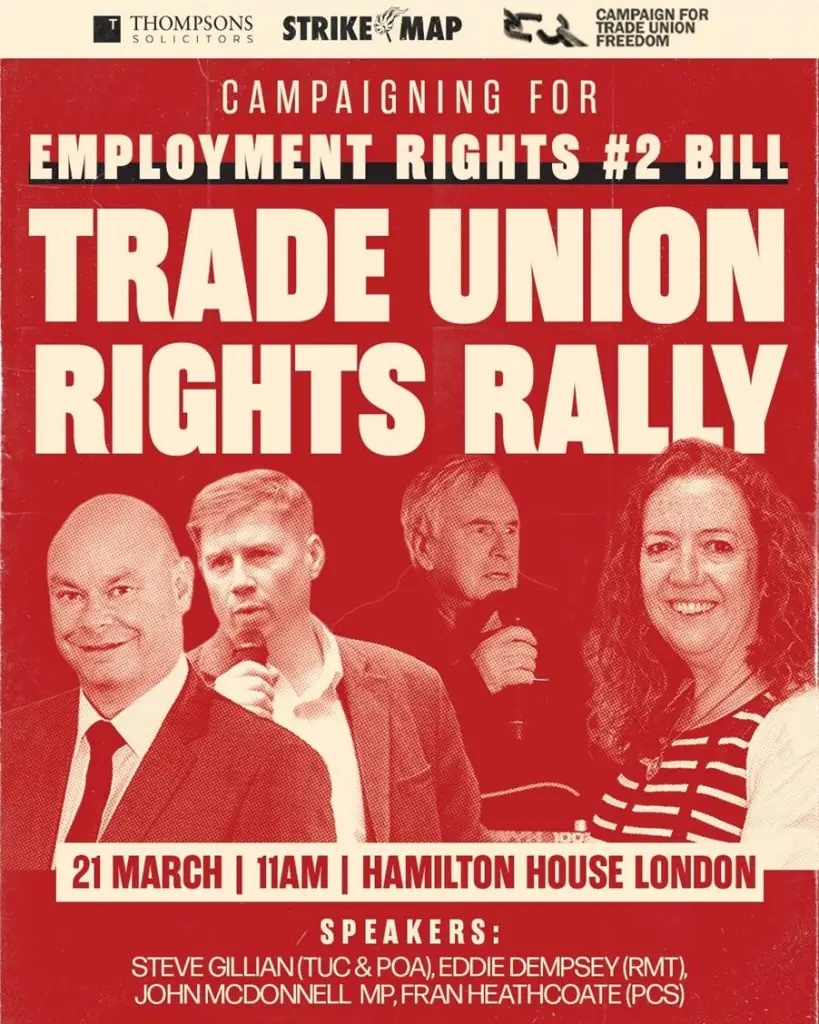
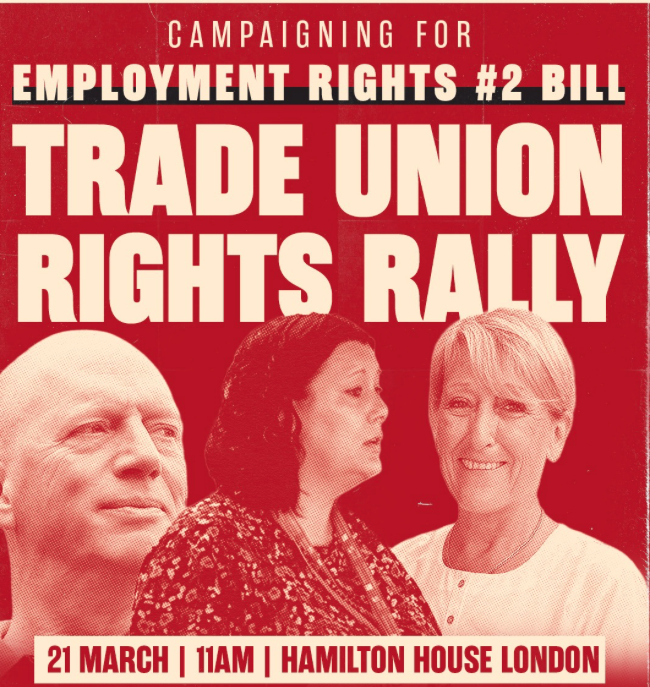
The Campaign For Trade Union Freedom will be holding a spring rally in London on 21st March to launch the campaign for a second Employment Rights Bill to close loopholes and bring forward the workers rights and protections promised in Labour’s New Deal For Workers. More information soon.
A historic advance for workers – and the fight to make it count

The Employment Rights Act 2025 marks the biggest expansion of workplace protections in a generation. But with key reforms delayed and crucial details still to be decided, unions must remain vigilant to ensure this landmark law fulfils its transformative promise, says Andy McDonald MP
The Employment Rights Act 2025 has now passed into law, marking the most significant advance in workers’ rights in a generation. For decades, trade unions and campaigners have argued for reforms that protect workers from precarious conditions, arbitrary dismissal, and exploitative practices. This Act delivers on many of those promises and represents a historic step toward the vision set out in Labour’s 2021 New Deal for Working People. Among its landmark measures, the Act guarantees protections around hours of work, creates powers to challenge unfair fire and rehire practices, and establishes day-one rights in several key areas.
It also strengthens trade union access to workplaces, initiates the possibility of e-balloting for industrial action, and lays the groundwork for collective bargaining in the social care sector. For the first time in decades, workers in some of the most vulnerable parts of the economy are being given tools to assert their rights and challenge exploitative practices.
However, the road to this moment has not been smooth.
Throughout the passage of the Bill, the employer lobby actively sought to water down the legislation. Whether through the Confederation of British Industry (CBI), the Federation of Small Businesses (FSB), or other employer bodies, many organisations pushed for carve-outs, longer qualifying periods, and narrower enforcement provisions. While ministers ultimately resisted wholesale dilution, the process demonstrated the ongoing tension between workers’ interests and entrenched business groups.
Another complication arose from the front-bench reorganisation during the Bill’s passage. Angela Rayner, who had been the responsible Secretary of State, and Justin Madders, the Minister of State overseeing the Bill, were both removed from their roles.
While Kate Dearden, who had been closely involved in establishing the New Deal for Working People, remains part of the team, the frequency of reshuffles caused by wider political pressures risks disrupting the continuity and relationships necessary to embed the best possible upgrade in employment rights.
Maintaining strong, consistent leadership within government is essential to ensure that the Act’s transformative potential is realised.
Critically, much of the detail of the Act will be determined through secondary legislation. That means the passage of the law is not the final step — trade unions and their parliamentary allies must remain vigilant to ensure these protections are implemented robustly.
Current consultations on trade union access to workplaces and on establishing social care collective bargaining institutions are pivotal moments where advocacy will shape how the Act operates in practice.
Even as we celebrate this historic achievement, it is important to acknowledge the measures still delayed or absent. Key proposals from Labour’s 2021 New Deal, such as moving toward a single worker status, extending blacklisting protections, broadening health and safety safeguards, reviewing Transfer of Undertakings (Protection of Employment) requirements, and ensuring public procurement actively raises employment standards, remain unfinished.
Additionally, there is no commitment to reform public-sector pay review processes to create a meaningful form of collective bargaining. These gaps leave substantial work for future campaigns.
A number of bold measures that remain unmet — full bans on “fire and rehire” with injunction powers for unions, the abolition of zero-hours contracts, single worker status with universal rights, the removal of restrictions on industrial action, and a proper minimum wage of £15 with uprating — have been advocated through the proposed Employment Rights Bill No 2 by Strike Map, the Campaign for Trade Union Freedom, the Institute of Employment Rights, the General Federation of Trade Unions, and other organisations. These proposals signal that the push for a truly transformative agenda is alive and growing.
The history of reform in Britain demonstrates the importance of sustained campaigning. Early compromises, such as the reduction of day-one unfair dismissal protections to six months’ qualifying service, illustrate the pressure unions face from both government negotiation and employer lobbying.
As a party and a movement, we had framed day-one rights as a moral imperative: no worker should live in fear of dismissal from the first day of employment. Yet, in practice, the government yielded under pressure from the House of Lords and business interests, leaving new employees vulnerable for nearly half a year before gaining full legal protection.
Critics may argue that these concessions were necessary to balance business concerns, but the reality is stark: under the current framework, workers who meet all expectations can still be dismissed arbitrarily, with minimal recourse. This is not an abstract scenario; it is the lived experience of countless workers today.
Moreover, employer groups continue to use consultations on secondary legislation as a platform to shape protections, highlighting the necessity of active engagement from unions and campaigners.
Despite these challenges, the passage of the Employment Rights Act 2025 is a moment to celebrate. It enshrines some of the most significant workers’ protections in decades and initiates reforms that could reshape employment practices across the country. Yet celebration must be paired with vigilance.
The union movement must ensure that secondary legislation strengthens, rather than undermines, the law’s intent. At the same time, support for a second, more ambitious Employment Rights Bill remains essential to complete the agenda begun in 2021.
The Act represents progress, but it is also a reminder that labour rights are not delivered once and for all — they are won, defended and expanded through persistent campaigning. This is a historic step, but it is not the final one. Working people, unions and advocates must continue to push for a world where decent work is not a privilege, but a guaranteed right.
Andy McDonald is Labour MP for Middlesbrough and Thornaby East.
An emasculated Employment Rights Act gets over the line
By Tony Burke, Co-chair of the Campaign for Trade Union Freedom
And so the Labour Government’s Employment Rights Act is finally through the House of Lords, as Tory peers faced the threat of sitting through Friday and Saturday in the week before Christmas.
The Tory peers were under great pressure from the CBI and other employers’ bodies worried about losing concessions they had already gained, day 1 rights extended to six months, so they dropped their final Amendment to the Bill (in regard to compensation payments from Employment Tribunals) after trying to wreck it altogether – aided and abetted by Lib Dems peers.
The Employment Rights Act is a long way short of what was promised in the Green Paper New Deal for Working People but nonetheless even in its diluted form it was a clear Labour manifesto commitment that the unelected Lords sought to water down even further to the point where Unite General Secretary Sharon Graham said it was “‘shell of its former self.”
Of particular note is the fact that the Bill was opposed by 47 hereditary peers in one vote and 33 in another that defeated the Government by 24 votes.
As the Campaign’s Lord John Hendy KC has pointed out there is the so-called “Salisbury convention that Bills fulfilling the Government’s manifesto commitments must be allowed to pass.”
He also notes “the struggle over the Employment Rights Bill, and the House of Lords’ repeated attempts to block the Government’s elected programme of stronger employment protections, is more than a quarrel about constitutional etiquette. It is a test of whether our democracy still has the capacity to deliver for working people.”
The Labour Government had already succumbed to pressure from employers on key areas of the Bill such as on zero hours, fire and rehire, day one rights, union rights to have access to workers. They sacked key ministers driving the bill through parliament – for no apparent reason other than to appease the employers’ lobby – causing disbelief and anger across the labour movement.
Unions, lawyers and employment law specialists warned that the essential content of the Bill was a platform of (although welcome) employment rights for individual workers, that mainly have to be enforced by application to the Employment Tribunal, rather than collective rights for unions and union members.
The average wait for an Employment Tribunal hearing is around 335 days (approximately one year) from the claim being lodged, longer for more complex cases. Research has shown that in 2013 51% of successful applicants were never paid their compensation by employers; in 2025 75% of applicants using the Government’s Employment Tribunal Penalty and Naming Scheme have not received their awards. Little wonder that unrepresented applicants would in all likelihood just not bother.
Previous experience with the Blair Government shows a Labour government is highly susceptible to pressure from the employers’ lobby, for example, the recognition procedures that allowed for non-independent unions to usurp rights originally thought only would be enjoyed by bona fide independent unions, said to have been enacted at the behest of the Murdoch print and media empire.
However, on more than one occasion Blair was confronted with concerted opposition from the House of Lords. On such occasions Blair faced down the Lords which was ultimately more successful than appeasement.
So after a deal was apparently done to set the qualifying period for ordinary unfair dismissal at 6 months we now have a still welcome (it would be churlish not to give it a welcome), but deficient, Employment Rights Act.
It may be that the movers and shakers in Congress House view the Starmer Government being one term only and will spend the next two years or so, before the next General Election, dealing with the innumerable consultations that will arise to give effect to the new rights through Regulations.
The Campaign for Trade Union Freedom however is calling for an Employment Rights #2 Bill to be introduced in this Parliament. The new Bill would be to implement the many areas of collective rights missing from the current version including statutory support for sectoral collective bargaining, the right to strike and to take solidarity action, a single status of workers and for proper and readily enforceable remedies.
The Campaign will be holding a major rally in March 2026 to campaign for an essential Employment Rights #2 Bill and to call for the Regulations related to the new law remaining consistent with the manifesto and for no further watering down during their drafting and consultation.
This blog first appeared on Labour Outlook https://labouroutlook.org/2025/12/19/an-emasculated-employment-rights-bill-gets-over-the-line-campaign-for-trade-union-freedom and then subsequently in the Morning Star https://www.morningstaronline.co.uk/article/emasculated-employment-rights-act-gets-over-line