
Category: UK Employment Rights


ITUC Global Rights Index 2025 – Workers’ rights collapse across the world
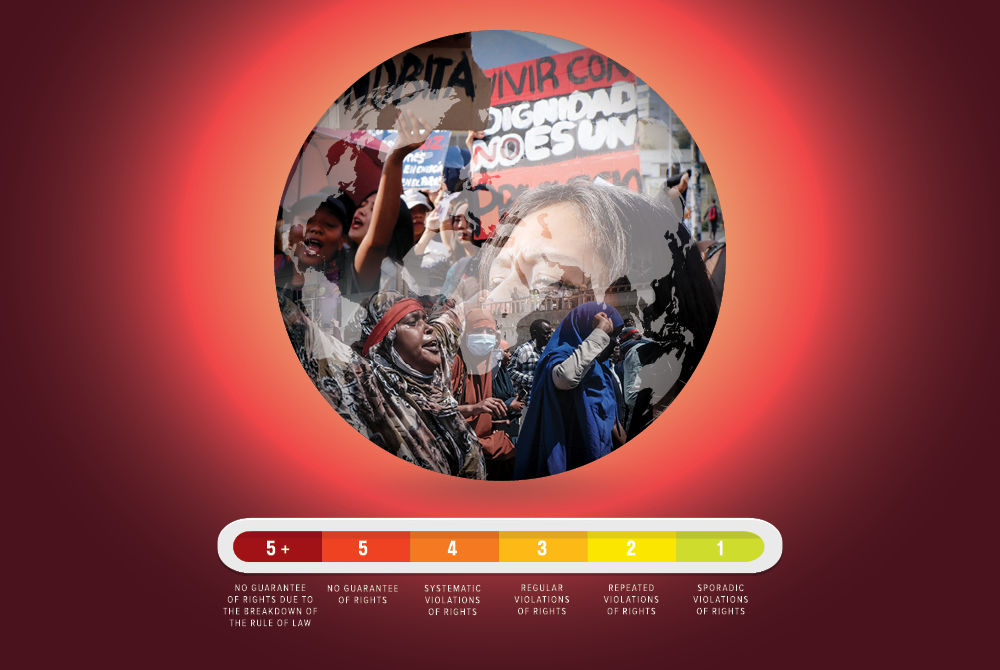
Workers’ rights are in free fall across every continent, according to the new 2025 ITUC Global Rights Index, with Europe and the Americas recording their worst scores since the Index began in 2014. Just seven countries now have the top rating of 1 for their respect for workers’ rights, compared with 39 rated 5.
If the current trend continues, no countries will hold a rating of 1 within the next ten years.
Key findings include:
▪Three out of five global regions saw conditions worsen; the Americas (3.68) and Europe (2.78) hit their worst scores on record. Europe continued a rapid deterioration from 1.84 in 2014 – the biggest decline seen in any region worldwide over the past 10 years.
▪Only seven out of the 151 countries surveyed (fewer than 5%) earned a top-tier rating of 1 – down from 18 a decade ago.
▪The 10 worst countries for workers are: Bangladesh, Belarus, Ecuador, Egypt, Eswatini, Myanmar, Nigeria (NEW), the Philippines, Tunisia, and Türkiye.
▪The worst region in the world for working people is the Middle East and North Africa, with an average rating of 4.68.
▪Deaths of trade unionists were recorded in Cameroon, Colombia, Guatemala, Peru, and South Africa.
▪87% of countries violated the right to strike; 80% violated the right to collective bargaining.
▪Workers’ access to justice was restricted in 72% of countries, the worst level ever recorded.

“The 2025 ITUC Global Rights Index exposes the outcomes of the betrayal of the system built after World War Two, founded on democracy, trade union rights and justice” said ITUC General Secretary Luc Triangle. “Governments have collaborated in decades of deregulation, neoliberalism, and neglect, leading to the collapse of workers’ rights. This has disenfranchised millions and paved the way for extremism, authoritarianism and the billionaire coup against democracy that now threatens democracy itself.
“If this pace of decline continues, in ten years there will be no country left in the world with the highest rating for its respect for workers’ rights. This is a global scandal, but it is not unavoidable; it is a deliberate decision that can be reversed.
“That is why the ITUC is exposing the coordinated attack by the ultra-rich and their political allies to rig economies against working people. It is not inevitable that workers’ rights will worsen in the 2026 Rights Index. “Together, through strong, independent unions and a democracy that delivers for all, we can reclaim power, rebuild economies that serve people, not corporations, and demand international institutions that are accountable to those they were created to protect. Our movement is fighting every day for this future — and next year’s Index must show the beginning of real change.”
Other key findings:
▪In 12 countries, conditions have deteriorated so severely, due to conflict and the corresponding collapse of the rule of law, that they now hold the lowest-possible rating of 5+. These countries are Afghanistan, Burundi, Central African Republic, Haiti, Libya, Myanmar, Palestine, Somalia, South Sudan, Sudan, Syria, Yemen.
▪Only three countries have seen their rating improve in 2025: Australia (2), Mexico (3) and Oman (3).
▪Seven countries have worse ratings: Argentina (4), Costa Rica (4), Georgia (4), Italy (2), Mauritania (5), Niger (4), Panama (4).
▪75% of countries excluded workers from the right to establish or join a trade union.
▪74% of countries impeded the registration of unions.
▪45% of countries restricted free speech and assembly.
▪Workers were arrested and detained in 71 countries.
▪Workers experienced violence in 40 countries.
The 2025 ITUC Global Rights Index is released to coincide with the start of the International Labour Conference (ILC) at the International Labour Organization in Geneva, Switzerland: the world’s parliament for work. ITUC priorities at the ILC include tackling rights violations through the Committee on the Application of Standards and the implementation of Article 33 measures concerning Myanmar, advancing protections in the platform economy, addressing biological hazards at work, and promoting innovative pathways to formalising informal work. The violations exposed in the 2025 Index will contribute this work.
The ILC will include a special session on the 2025 ITUC Global Rights Index at 13:30 CEST on 10th June that will include testimonies from trade union representatives from some of the worst countries in the world for working people, as well as remarks from Luc Triangle, ITUC General Secretary, and Paapa Danquah, ITUC Legal Director.
The ITUC Global Rights Index is a comprehensive review of workers’ rights in law ranking 151 countries against a list of 97 indicators derived from ILO Conventions and jurisprudence, and as such is the only database of its kind. Violations are recorded each year from April to March.
Employment Rights Bill – Suggested Amendments: write to your union
 The Employment Rights Bill is now being discussed in the House of Lords. The Bill as it currently stands offers the promise of much needed gains for working people. But, with a few tweaks, the Bill could offer so much more.
Lord John Hendy KC has been diligently drafting a limited number of amendments in an attempt to improve the Bill on issues of importance to the trade union movement. The debate in the Lords is due to continue on 3rd, 5th and 10th June – so time is short!
Below is a list of the topics covered by Lord Hendy’s amendments. Many unions work closely with parliamentary representatives in both the Commons and the Lords. It would be extremely helpful and much appreciated if union members and CTUF supporters could forward this list to your union or your amended version of the list – expressing your support.
Details of the amendments will of course be available to members of the Lords – they are extensive so circulating this with the amendment numbers and the subject matters would be helpful.
Please note the following amendments as follows:
- 143 to permit injunction to prevent breach of s.188 collective redundancy requirements;
- 152-173, 176-179 to convert school support staff negotiating body into proper collective bargaining;
- 181-187, 191, 193-4, 197-199 to convert adult social care negotiating body into proper collective bargaining;
- 203 to provide a mechanism to introduce sectoral collective bargaining into any sector of the economy;
- 214 to permit injunction to compel union access if ordered by CAC;
- 238 to provide a positive right to strike;
- 239 to make it lawful to strike over dismissal of unofficial strikers;
- 240 to permit secondary action;
- 241 to permit strikes to gain recognition;
- 242 to omit obligation to give notice of ballot to employers;
- 243 to omit the distinction between separate and aggregated ballots;
- 249 to omit obligation to provide postal notice of ballot result to members and employer;
- 251 to simplify notice of strike to bare minimum;
- 253 to return the right to strike to the POA;
- 257 to return the obligation to promote collective bargaining to ACAS;
- 260 SoS to formulate action plan to achieve 80% collective bargaining coverage, as in EU.
Employment Rights Bill Does Not Empower Workers – Unions Must Demand More Says John Hendy KC

The Employment Rights Bill falls short of redressing the imbalance of power between workers and employers and trade unions need to push Labour harder to improve it, Lord John Hendy KC told the GFTU union federation conference.
Lord Hendy said the law would improve current workplace rights, citing positives including improvements to sick pay and parental leave, as well as better union rights to access workplaces.
But “if you judge it against the standard of the Labour Party policy adopted in 2021, it falls far short,” he warned.
It would not empower workers collectively, because it does not restore sectoral collective bargaining and because it leaves untouched the bulk of anti-union legislation dating back to Thatcher, including, crucially, the right to take solidarity action.
Lord Hendy said he was unsure why adult social care and school support staff had been identified as areas where a negotiating body will be set up to determine pay and conditions, “instead of sectors where it’s even more needed, like agriculture or hospitality — some particular unions had leverage over that maybe.
“But it’s important to know that there is no mechanism in this Bill by which sectoral collective bargaining can be introduced by law in any sector — not in adult social care or for school support staff,” highlighting that the subjects for negotiation will be decided by the secretary of state, and the law says unspecified third parties, in addition to workers and employers, will be represented in the talks as well.
The Bill was not strong enough and unions should not be satisfied with it but put pressure on the government to deliver more, he insisted.
This article first appeared in the Morning Star May 20th.